The beginning
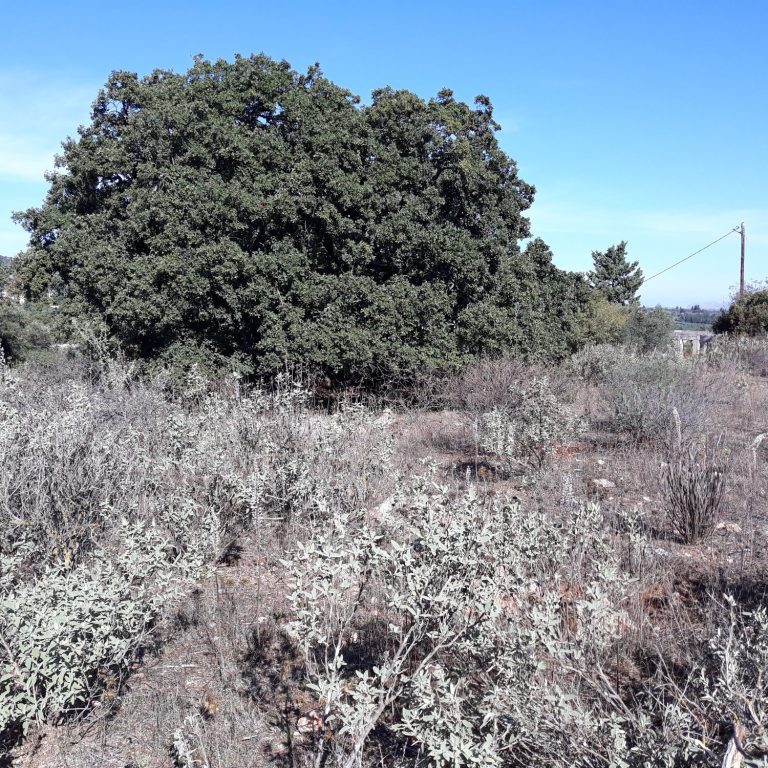
When we bought this property we found an ambigous situation:
In the foreground you see former farmland, which has afterwards probably been grazed exclusively by sheeps and goats for the last 80, 90 years.
In the background an old tree that shows the ingenuity and power of Mother Earth:
Diameter of the tree-crown 26 meter
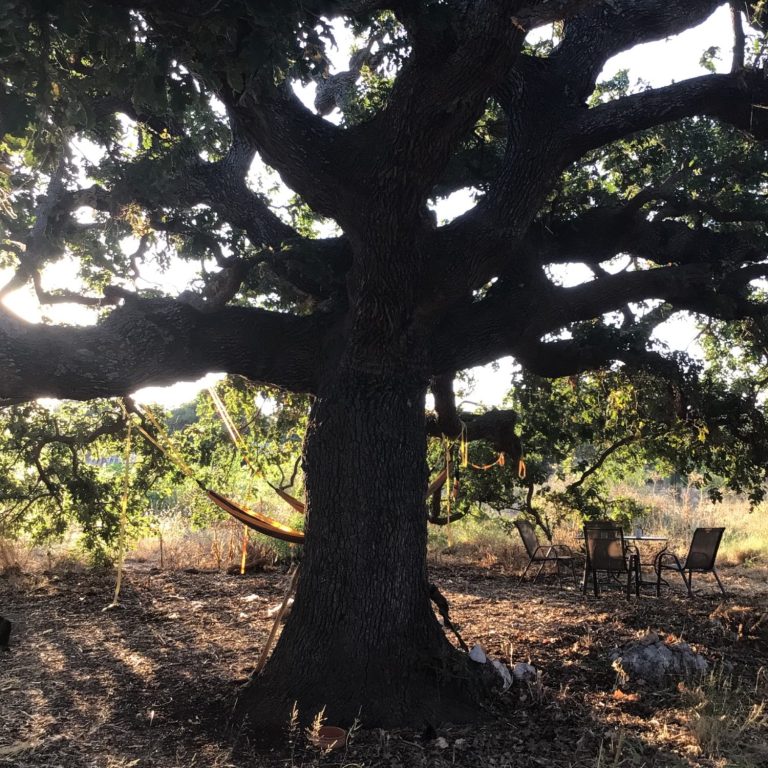
circumference of the trunk 241 cm
Without iriigation, this OAK-TREE is self-sufficient:
Every year it goes into a short winter rest and drops all its leaves in January.
Over time, the leaves that have fallen to the ground will turn into fertile humus, which the tree in turn feeds on.
In summer the conopy of leaves provides wonderful shade.
In November the crown thins out, more light falls on the area below the tree und thus enables another plant to grow:
angelica archangelica, an ancient medicinal plant.
Then the cycle starts again...
With the rainy winters in Apokoronas, this OAK-TREE has been able to support itself for the last 300, 350 years.
This is nature's example.
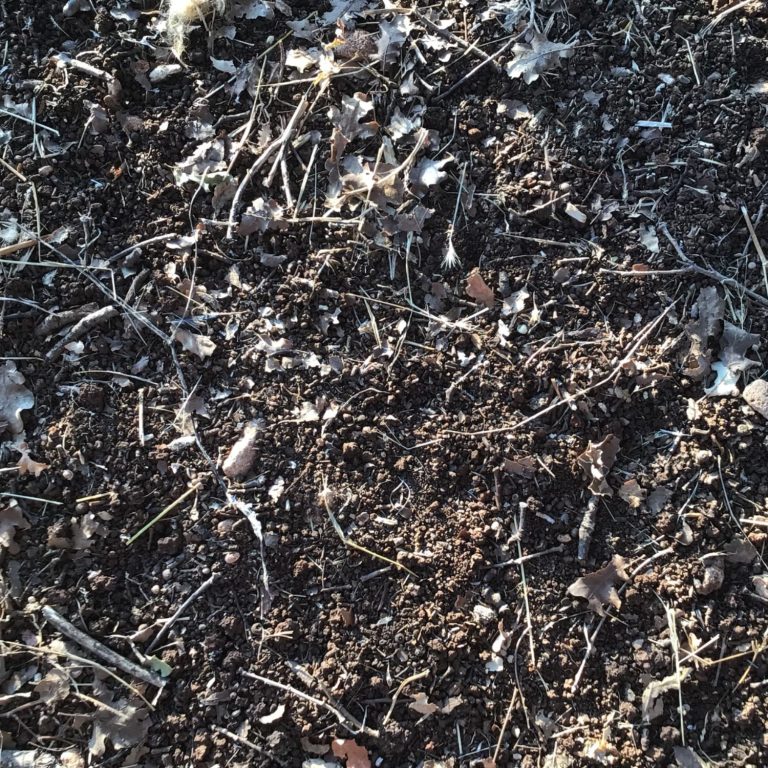
dark, fertile humus under the OAK
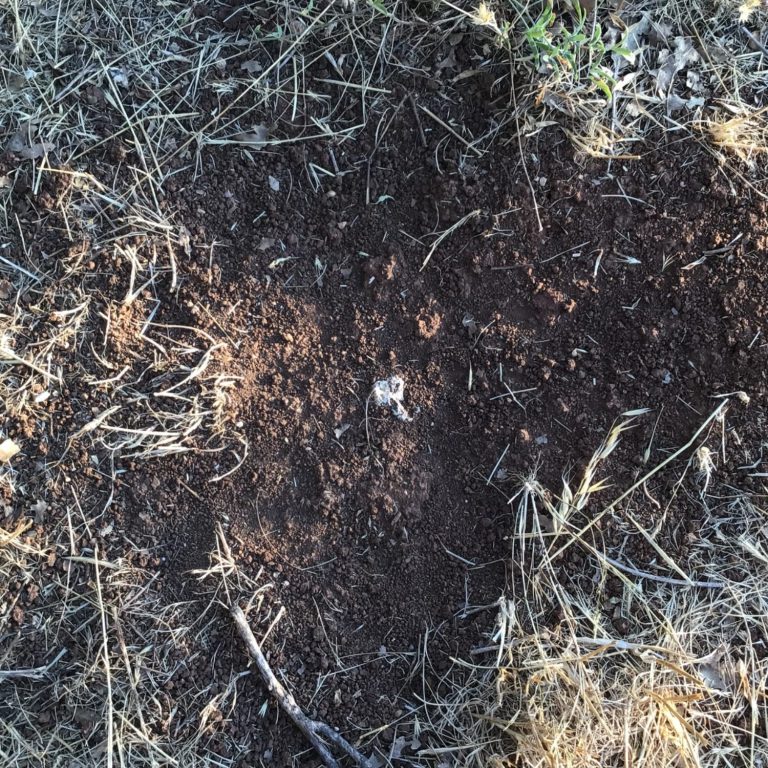
just two meters from the OAK tree
the red earth (terra rossa) that is so common on Crete
One question stuck with us:
What was the original condition of this piece of land? The original condition of Apokoronas, of Crete?
It was clear to us that one could not speak of an original condition - even nature, left to its own devices, is in constant change. Our question was more precise: What did it look like before humans get involved?
Below is a short, simplified answer to our question.
Ancient authors such as Theophrastus and Pliny the Elder describe Crete as rich in forests and all fruitful. In the Ida-mountains and the White mountains, the Cretan cypresses are said to have even grown on the peaks where the snow never completely melted due to the shade.
Also the Athenian Philosopher Plato was impressed by the fertility of the island Crete.
He knew about ecological connections that changed his home region Attica. He was already writing back then (!) that in the past the fertile earth absorbed the annual rainwater from Zeus. This stored water in the ground fed abundant springs and rivers in all places.
But the consequences of human influence led to severe erosion. The philosopher regrets that the bare, less fertile earth in Attica is no longer able to store the annual rainfall. Precious rain-water flows unused into the sea.
Plato's book Critias "is the earliest document in existence that clearly describes human-induced enviromental degradation."
J. Donald Hughes
It is probably no coincidence that this philosopher built his fictitious ideal state Magnesia on Crete in his late work (Nomoi I, 625 b-c).Plato knew about the value of dark fertile humus and the ecological wealth of this island Crete at that time.
But unfortunately this island has also been heavily modified by humans over the last 2400, 2500 years since than:
By deforestation for their shipbuilding, the Venetians changed the ecological balance so massively that the forest could no longer recover.
After conquering the island, the Ottomans introduced olivetree-monocultures on a large scale. Around 2,7 million liters of olive oil were taxed around 1670 AD, in good years in the late 19th century this value rose to around 55 million liters (Şemsettin Sami, Kamūs al-Aʿlām vol. 6, pp. 3853–3855 (AH 1314 / c. 1896–1897).).
These on large scale planted trees differs from the oak tree described above in one crucial aspect:
The olive-tree don't drop his leaves, so he don't build up fertile humus. The monocultures of olive trees contribute to erosion of the good, black soil.
What the philosopher Plato wrote at the time about his home area Attica, now also applies to many areas of the island Crete:
“And so what is left now, in comparison with what existed then, is like the bones of a body wasted by disease: all the rich and soft earth has been washed away, and only the thin skeleton of the country remains.” (Plato, Kritias 111d)
What to do?
The problem is obviously not the olive tree that does not shed his leaves. The problem is probably the arrangement of the trees according to human design.
The following graphic turned our idea of gardening on their head:
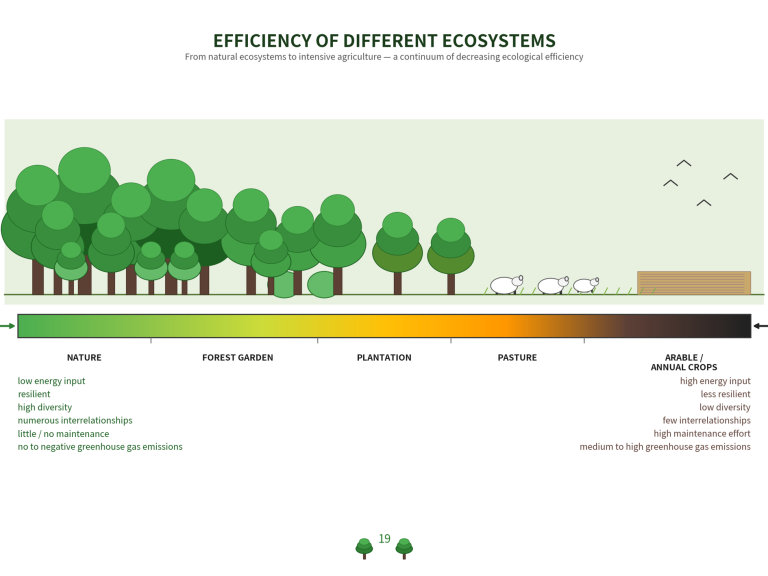
Martin Crawford: Creating a forest garden - Working with the nature to grow edible crops, 2010, page 19.
fruit forest and annual crops: Diametrically opposed human design models for dealing with the garden
„Do nothing and everything will be done.“
— Masanobu Fukuoka,
The One-Straw Revolution (1975)
"The vegetables grow on the hoe.."
My wife's Great-Grandmother Ida,
God bless her
With these findings, our decision quickly became clear.
.